

Demystifying the publishing sphere
What I learned from professional editors last semester

As those of you who follow my Instagram know, last semester I took a course at my college called “Editing and Publishing,” which focused on professional writing and the publishing industry.
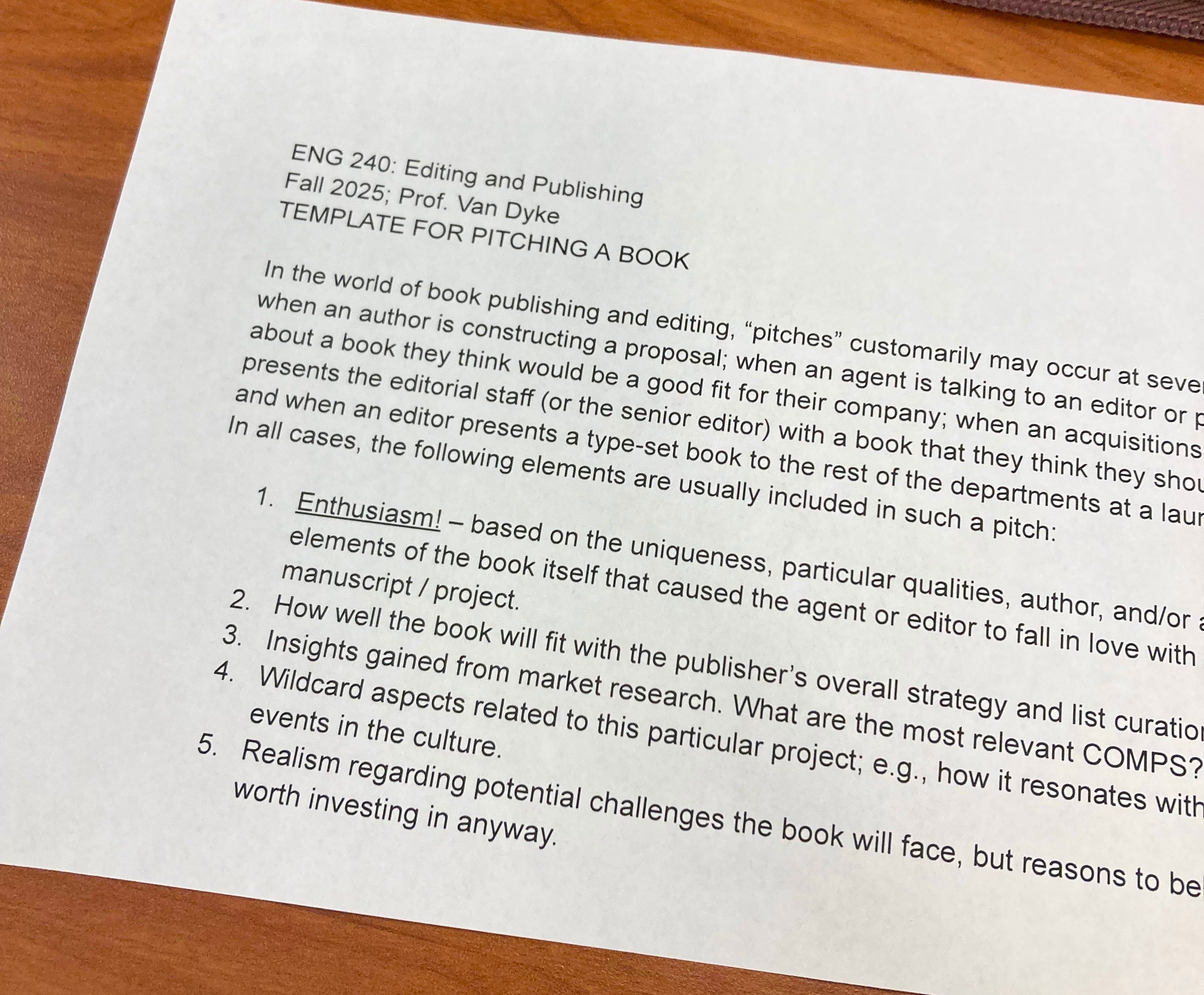
As an independent author, I can’t stress how valuable this class was—not only because of what I learned, but also because of who I learned from. Two editors from traditional publishing companies visited to talk about their experiences and the current state of publishing.
In this post, I’ve compiled the notes I took during those conversations. I hope that all writers—whether unpublished or published, or traditional or independent—enjoy this glimpse into the publishing sphere. I certainly did!
Before we begin, I’ll briefly introduce the two editors. Amy Nemecek is a Senior Project Editor at Baker Publishing Group, and Amanda Halish is a Senior Managing Editor at HarperCollins imprint Zondervan.
Although there are some differences between their positions, the two handle similar tasks in similar areas. Below, I’ve divided their insights into subsections and emphasized the terms and information I find most relevant.
Disclaimer: All this information is intended for informational and educational purposes only, and the writer is not liable for any errors, inaccuracies, or omissions.
Typical Work Day/Week
As a Senior Project Editor, Amy Nemecek tends to work a hybrid schedule: she spends part of her time in the office and part of her time doing virtual work at home. As part of her daily work routine, she catches up on emails, receives and processes invoices, works on manuscripts, proofreads covers, and attends meetings with the Publishing Board or other departments.
At Baker Publishing, the team of editors may choose from unassigned projects based on the book proposals. Amy copyedits and fact checks manuscripts in Microsoft Word (while locking “track changes”). “I like to read the book as a reader and set it aside for a few days,” she explained. This helps her know how to edit in order to preserve and enhance the author’s unique voice. Then, she sends all edits to the author and hires proofreaders for the manuscript. Often, she works with the same authors.
By contrast, as a Senior Managing Editor, Amanda Halish is the project manager of the “whole life cycle” of the book. She deals with acquisitions, assigns editors to books, meets with editors and designers, works with the production team, handles post-release issues, and completes some copyediting projects on the side. She personally handles 35-40 titles per year.
Amanda’s typical day-to-day tasks involve running financials, performing final checks on manuscripts, starting cover routing, adding cover/copy changes to the system, and asking the production team to fix binding errors. She compares herself to an air traffic controller: “My goal is to prevent crises and maintain effective frameworks,” she explained.
Publishing Process
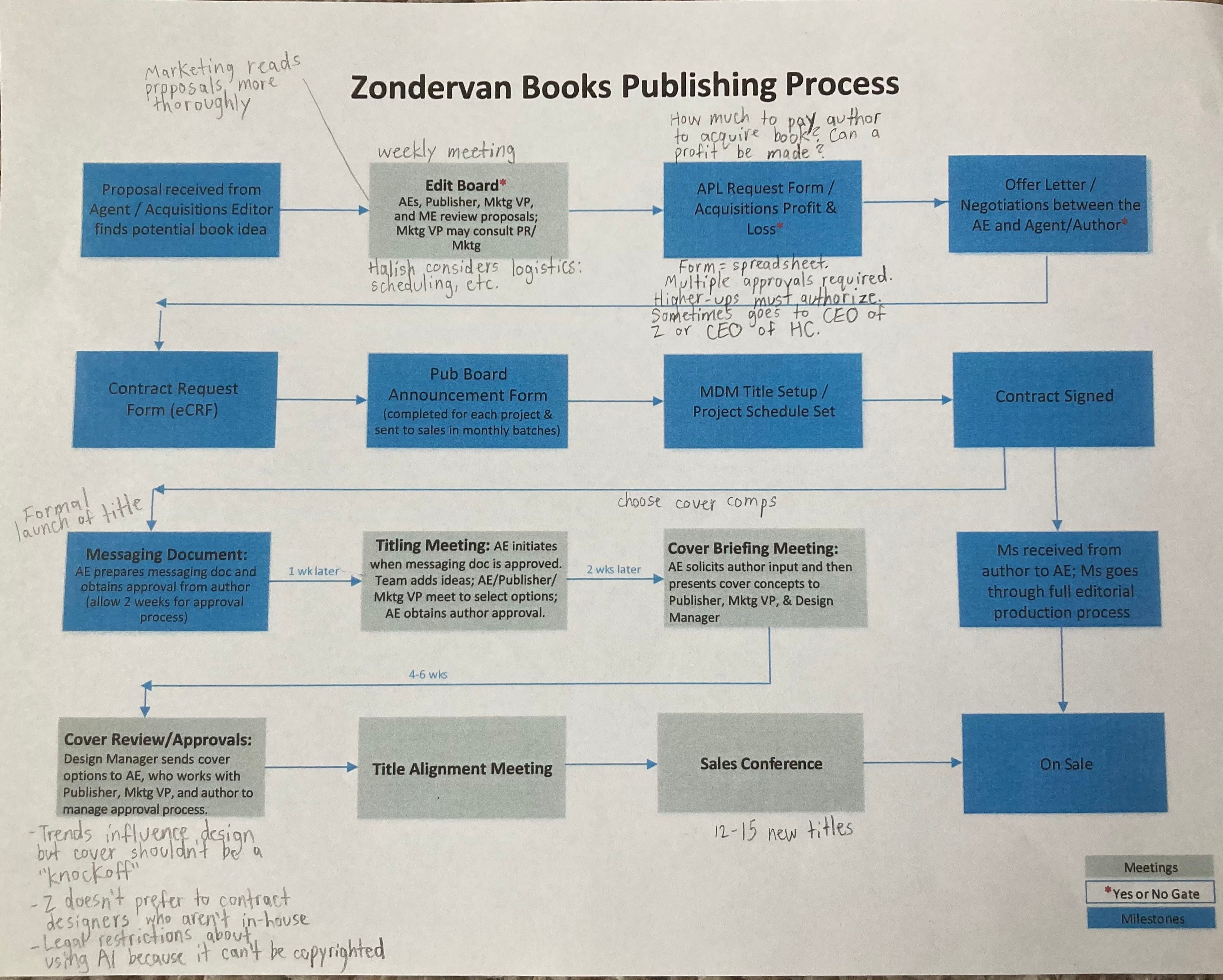
When Amanda visited my class, she passed out the following sheet, which shows an overview of the publishing process at her company, Zondervan. This process may differ depending on the publisher, but the general steps remain the same.
The Role of AI
These days, it’s not so much a matter of which publishers are using AI, but rather which tasks publishers are using AI for. According to Amy, AI may be used to write copy or to fact check, although corporate rules prevent her from using it.
I was also surprised to learn that some publishers use private subscriptions to AI services (such as Claude) to protect unpublished works from being scraped.
Design & Production
During the design and production stage of a book, the manuscript is typeset and formatted as a PDF, and it is proofread multiple times. Amy noted that an apprenticed job in printing is a good way to break into publishing work because “you can learn as you go.”
As a production editor, Amanda Halish holds meetings with editors and designers, and works with the production team. She compiles edits and sends them to the design department. While she’s communicating with the author, Design creates sample covers for the book.

Amanda also described the process of pass pages. First pass pages are a preview of the layout of the book. The author and proofreader both look over these pages at least once. After that, second pass pages are created, and the managing editor approves these for printing.
Advanced Reader Copies (ARCS) typically consist of first pass pages. (Second pass pages can be used for ARCs, but first pages are generally preferred.)
Book Lists
Publishers divide the year into three lists: Spring, Summer, and Fall. These lists determine the release date of a book. Because publishers want to take advantage of readers during the holiday season, tasks tend to pile up during fall.
Both Amy and Amanda observed that they are busiest during October and November. Amanda said that her publisher’s goal is to have books selling by mid-October; at that point, no more new books are sent to the printers.
The Importance of Preorders
Every year, dozens of bookstores hold incentives for readers to preorder books. For example, when Barnes & Noble recently held their annual preorder sale, hundreds of authors—especially debut authors—promoted it on their social media and in their newsletters. Why is there such an emphasis on preorders?
Preorders drive the quantity of books that Amazon buys from the publishing house. In other words, it indicates reader demand. Not only that, but when preorders ship on launch day, the book is boosted in the algorithm. Because of that, book launch strategies often focus on maximizing the number of preorders.

A quick side note for any aspiring independent authors: Amazon Kindle Direct Publishing does not allow preorders for physical books (paperbacks or hardcovers). If you self-publish on KDP, you can only set up preorders for ebooks.
Author Advances
From Amy Nemecek, I learned that an author’s advance is based on first-year sales and is paid in royalties. The money is typically dispensed in thirds: the author receives one third after signing the publishing contract, one third after submitting the final manuscript, and one third after the book releases on the market.
Freelance Work
Amy had extensive experience as an editing freelancer before finding her current job, so I asked her if she had any tips about freelancing and filing taxes.
“Make sure you keep detailed records of your income,” she advised. “Full-time freelancers usually use TurboTax or hire tax consultants.” Also, the U.S. requires specific tax forms for self-employed people.
Closing Thoughts
If there’s one thing I appreciate more after hearing from these editors, it’s that the publication of a book is, above all, a labor of love. So many dedicated, talented people work behind the scenes to put a title on the market. And not only do they love what they do, but they are also deeply passionate about bringing stories to readers. Trends and technology might shift the state of publishing, but the core mission remains the same: to uplift great books by great writers.
Thank you to Amy Nemecek and Amanda Halish, who graciously gave their time and expertise to my class. I hope that all those who read this post come away with a better understanding of publishing and the people behind it.
such a great insight into the process, thanks
Always interested to hear more about this sphere! Thanks for the valuable information!